

Kernel Data Protection (KDP) is a Windows 11 VBS feature that allows drivers to protect their data from being modified by other kernel drivers or malware that achieved kernel write access. It actually contains two separate features: static and dynamic KDP. Static KDP, that allows drivers to enforce read-only protection on a data section be enforced through Hyper-V SLAT, was documented in 2020 but is still only used by very few drivers. Dynamic KDP, also called the secure pool, was never officially documented by Microsoft and was mainly (ab)used by Alex Ionescu and me to leak (see Paged Out #4 page 43 and vulnerabilities described here) data from VTL1 or cause VTL1 data corruption.
Sadly, the secure pool was removed in 26H2. In future builds it is replaced by another feature that is much closer in its implementation to static KDP but allows more flexibility. The feature doesn’t have a public name yet, but some functions and variables use the term “KDP Pool” so I will use it here too.
Unlike the secure pool which was available to any driver, KDP Pool is currently an internal feature in ntoskrnl.exe. But since its design (that I’ll describe in the next section) doesn’t add any new kernel or hypervisor functionality, developers can easily recreate it in their own driver if they choose to.
Design
KDP Pool works on the same principal as static KDP: a dedicated driver section named “KDPRO” is initialized with data that should be protected, and a call to the secure kernel enables read-only enforcement through the hypervisor SLAT. The main difference is that in this new data section the variables and their sizes don’t have to be declared in advance.
The KDPRO section is found immediately after the CFGRO section, which contains a pointer to the KCFG bitmap and other data related to management of KCFG, and is protected in a similar way. At the moment the KDPRO section is sized 0x2000 bytes (2 pages) but it could grow in future versions if more data is added to it. Most of the first page contains pre-defined variables – hard-coded strings, function tables and variables such as pointers to SIDs and DACLs that will be initialized by the kernel. The rest of the section is empty and leaves room for dynamically sized data.
When the kernel first loads, neither the KDPRO or CFGRO sections are protected. The kernel needs to initialize all the data inside those sections, which it does during phase 1 of kernel initiation. At the end of this phase, calls to MiProtectKernelRoDataSectionsSlat and MiProtectKernelRoDataSectionsVa request that the hypervisor make both these sections read-only, so their contents can’t be modified, even by a ring 0 attacker (unless they can execute kernel-mode code).
Allocation
As mentioned above, there are two types of data stored in the KDPRO section: pre-defined variables, that get set like any others, and dynamically sized data that is not known at compile time. To handle the second type, the end of the pre-defined data in KDPRO has a ExKdpPool variable followed by an unnamed variable I chose to call ExKdpPoolCurrentSize. ExKdpPool is treated as the beginning of a new pool type, where data can be allocated using the new internal function ExKdproPoolAllocate:
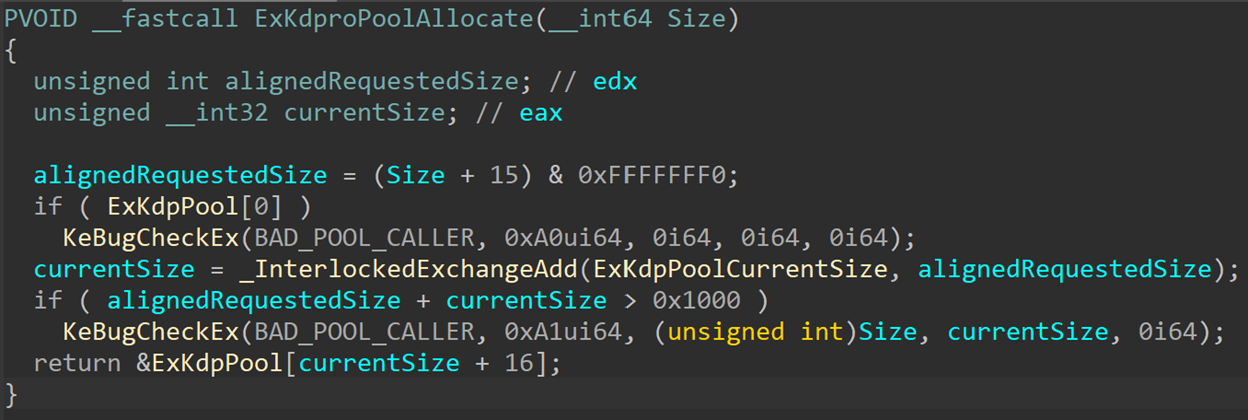
Since this is not a real pool, allocation is much simpler than “real” pool allocations. ExKdproPoolAllocate receives the requested size, aligns it to 0x10 and adds it to ExKdpPoolCurrentSize, which always stores the number of bytes currently allocated in the KDP “pool”. The current limitation is that the total number of allocated bytes must be less than 0x1000. The function returns a pointer to the end of the last block allocated in the “pool” (the first allocation is at ExKdpPool + 0x10, so 0x10 bytes are always added to the current byte count).
Unlike normal kernel pools, this pool has no randomization – all blocks are allocated one after the other. But since this “pool” is only written to by ntoskrnl, and only during early boot phases, it is not at risk for the same types of attacks that affect real pools so randomization and extra mitigations are not needed.
Also, since this “pool” is used for data that needs to be initialized once and then remain resident for the entire lifetime of the system, there is no API to free individual KDP pool blocks.
Protection
After all the data has been allocated in KDPRO, the kernel needs to make a call to the secure kernel to protect the section. This is done through calls to MiProtectKernelRoDataSectionsSlat and MiProtectKernelRoDataSectionsVa, which will protect both KDPRO and CFGRO sections. Internally, MiProtectDriverSectionPte (the same function used to protect a data section in static KDP) will call KeSetPagePrivilege with flag 0x80 to call VslRegisterProtectedPage and register the sections pages as protected pages. Like all Vsl* functions, VslRegisterProtectedPage is a wrapper around a secure call (you can read about secure calls in this excellent writeup by Connor McGarr).
This secure call, with code SECURESERVICE_REGISTER_PROTECTED_PAGE (262 on preview build 29531), registers each page in the protected section with the secure kernel so an NTE is created for it.
(A very brief intro to NTEs: The secure kernel has its own address space, separate from the VTL0 address space. It has page tables that represent its own virtual address space, but it is not “aware” of VTL0 pages unless it is “told” about their existence and identity. VTL0 can register pages with the secure kernel to make it aware of them — that allows the secure kernel to monitor the pages or manage their protection. To manage VTL0 pages, the secure kernel uses a table of NTEs (Normal Table Entry) – a data structure similar to a PTE (Page Table Entry). The secure kernel can’t manage VTL0 pages that do not have a corresponding NTE, so registration is a required step.)
After a page has been registered, the kernel makes another secure call, this time with code SECURESERVICE_PROTECT_KERNEL_DATA_PAGE (274 on preview build 29531) to request that the secure kernel sets the page’s protection as read-only in the SLAT.
This protects the section pages from being modified by a VTL0 attacker with kernel write primitive – setting the “write” bit in the PTE will not change the SLAT protection. Only an attacker with kernel code execution can issue a secure call to unprotect the page and make the section writeable again – but at that point they hardly need to change any of the variables stored there.
What Data is in the KDP Pool?
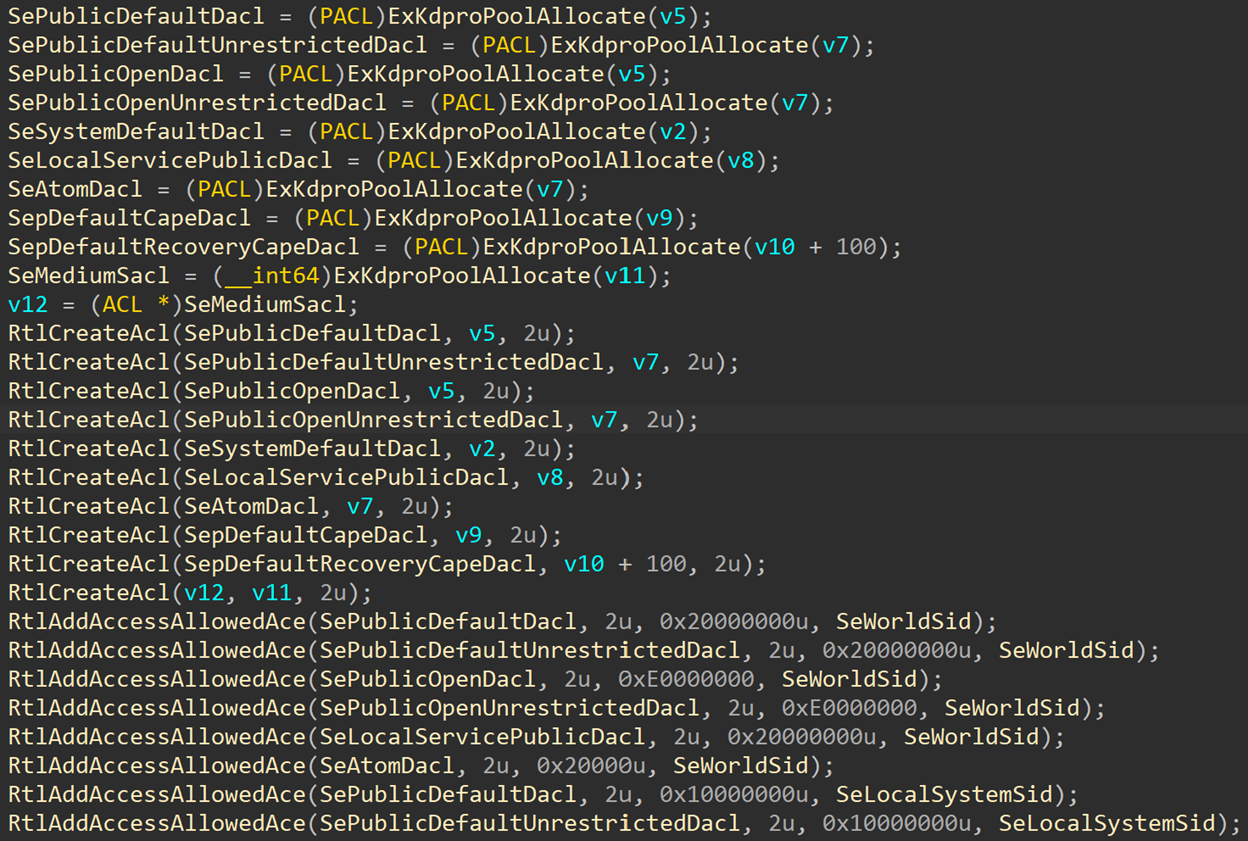
In current preview (26H2) builds, the only kernel library that allocates data in the KDP pool is the security library. This library is responsible for managing tokens, users, security descriptors, access checks, AppContainers, silos, etc. It uses the KDP pool to store data that is at high risk of being overwritten by an attacker with a kernel arbitrary write vulnerability: well known SIDs, DACLs, ACEs, privilege values and default security descriptors:
Imagine an attacker with an arbitrary kernel write primitive, using it to overwrite the global variable SeDebugPrivilege. This privilege is normally only granted to admin tokens, and must be enabled by the process. Processes with debug privileges can debug any process, attach a kernel debugger to the system (if Debug mode is enabled at boot), generate a memory dump and leak kernel pointers (since 24H2). But what if an attacker doesn’t modify its own token (or steal the SYSTEM process token, as many exploits do) but instead modify the value of SeDebugPrivilege? By default, the standard user token contains five privileges: SeShutdownPrivilege (19), SeChangeNotifyPrivilege (23 – enabled by default), SeUndockPrivilege (25), SeIncreaseWorkingSetPrivilege (33), SeTimeZonePrivilege (34). If an attacker overwrites SeDebugPrivileg to change it from 22 (its normal value) to 23 (SeChangeNotifyPrivilege), all kernel paths that check if SeDebugPrivilege is enabled in the process token will return TRUE, allowing unprivileged processes to access powerful capabilities.
The same method can be applied to other privilege values, SIDs, DACLs, etc, to bypass security checks and receive access to resources and capabilities.
To protect from these types of attacks, the security library moved SeDebugPrivilege and many other variables to the KDPRO section. Default ACLs, such as SePublicDefaultDacl, SeSystemDefaultDacl and SeMediumSacl, that have a size which is not known at compile time, get allocated during boot using ExKdproPoolAllocate. SIDs (well known, user SIDs, trust SIDs and capability SIDs) also get allocated in the KDP pool and pointed to by variable in the first page of the KDPRO section.
Of course, not all security-related data is protected this way. Tokens are still allocated in the normal kernel pools, as are dynamic security descriptors. There are also default security descriptors that are managed by other libraries and were not moved to KDPRO, like WmipDefaultAccessSd (that points to WmipDefaultAccessSecurityDescriptor) that is used as a default security descriptor for WMI and ETW objects.